
POSTER vsac
2026
https://2026.vsac.eu/
avec Bilge Sayim
| Laboratoire de Sciences Cognitives et Psycholinguistique (LSCP), Département d’Études Cognitives (DEC), École normale supérieure (ENS)
| CNRS, Paris, France
The Visual Science of Art Conference (VSAC) 2026 brings together designers, scientists, artists, engineers, and innovators to explore how visual perception and artistic practice intersect to shape human experience and interaction with the world. The conference examines how insights from perception and art advance our understanding of visual experience and inform creative practice, scientific inquiry, and the development of intuitive and effective technologies. Hosted by the Department of Engineering at King’s College London, UK from August 20–22, 2026, this year’s event highlights design as a critical interface between humans, complex systems, and technologies, showing how artistic and aesthetic approaches can help us understand, model, and enhance perceptual processes.
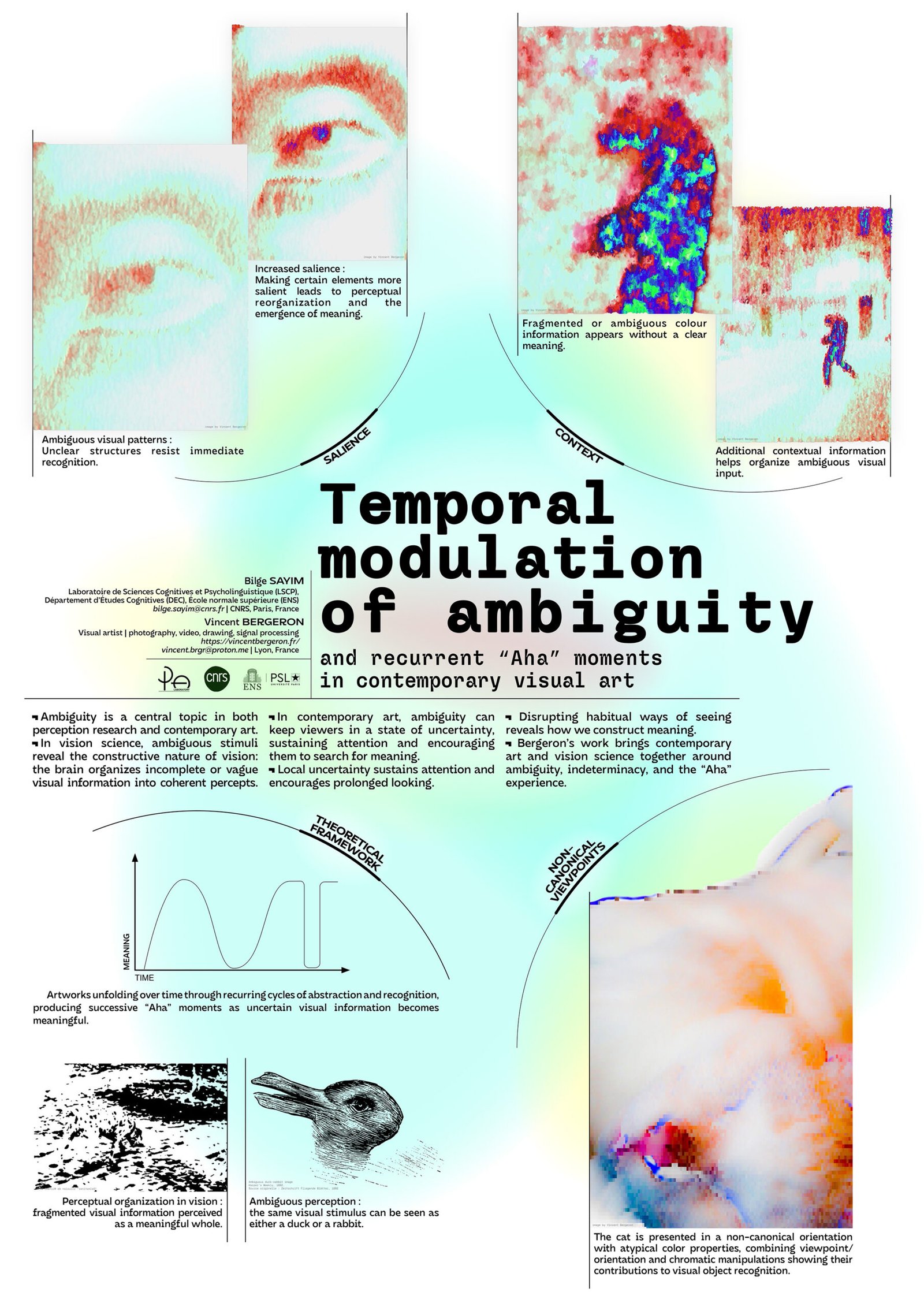
Temporal modulation
of ambiguity
and recurrent Aha moments
in contemporary visual art
Ambiguity is a central topic in both perception research and contemporary art. In vision science, ambiguous stimuli reveal the constructive nature of vision, showing how the visual brain organizes incomplete and vague visual information into coherent percepts. In contemporary art, ambiguity is used as a strategy to keep viewers in states of uncertainty, sustaining their attention and encouraging the experience of searching for meaning in visual patterns, while drawing on perceptual principles investigated in vision science. Here, we present and examine works by Vincent Bergeron, who explores transitions from indeterminacy and ambiguity to recognition through visual compositions that unfold over time. He draws on mechanisms of visual perception in order to use them as narrative tools within his work. The works employ fragmentation, temporal smearing, contrast variation, and color manipulations to interrupt and delay the recognition of objects and scenes. These artworks sustain attention by producing recurring cycles of abstraction and recognition,
yielding a succession of “Aha” moments in which indeterminate visual information becomes organized into meaningful percepts before dissolving again into uncertainty. Even when the global scene becomes perceptually clear, local uncertainty often remains. We suggest that the alternation between these perceptual states enables viewers to remain in prolonged states of aesthetic experience. The fluctuation itself is central to the aesthetic experience: indeterminacy and ambiguity intensify visual attention and involvement with the art work. By disrupting habitual modes of seeing and requiring viewers to look and search for extended periods of time, these artworks highlight vision itself and reveal the perceptual and cognitive mechanisms through which viewers construct meaning from uncertain visual information. They establish a direct link between contemporary artistic practice and vision science through a shared focus on perceptual ambiguity, indeterminacy, and the “Aha” experience.